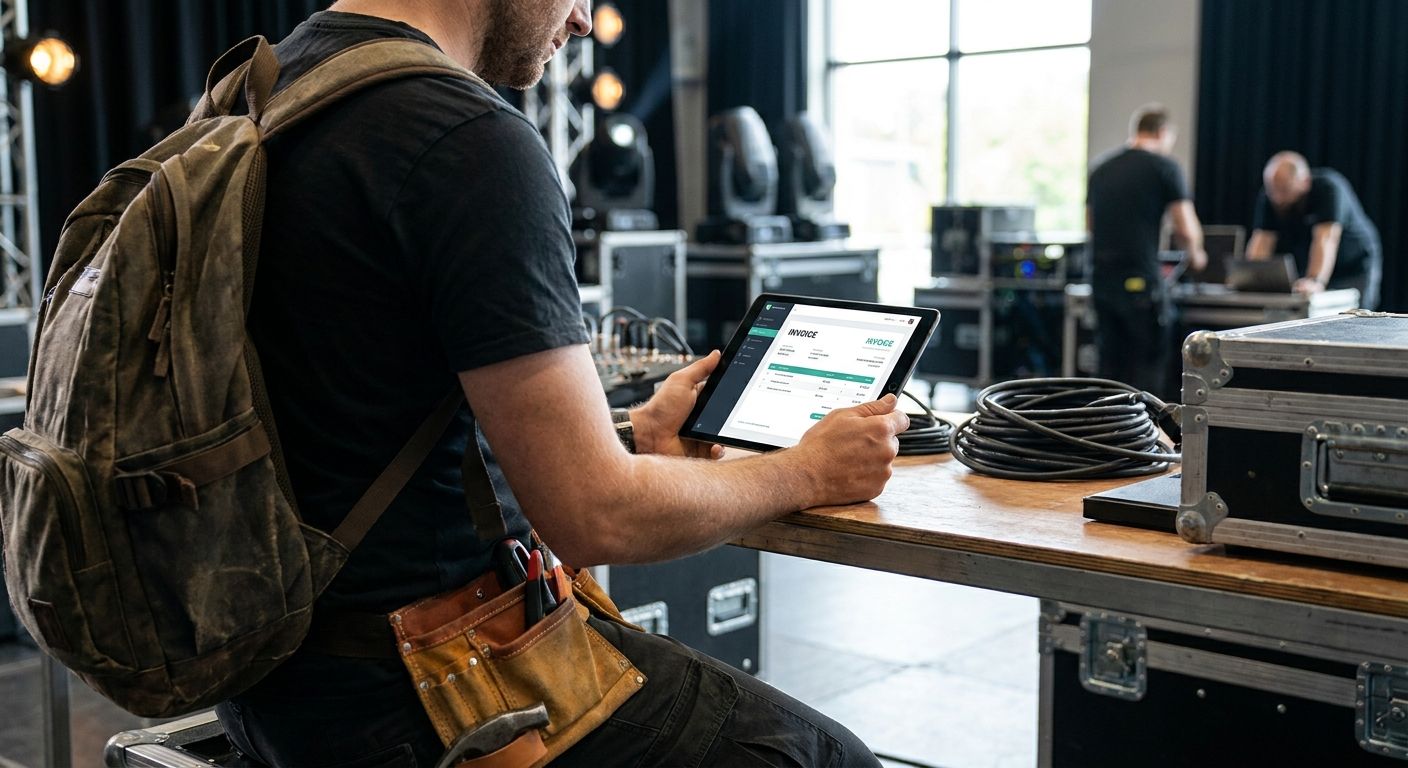
Freelance stagehands and AV techs juggle invoices across five or six different production companies in a single month, and generic accounting software rarely handles the day-rate, per-diem, and gear-rental line items that gig-based touring work actually generates. This guide ranks the invoicing apps that hold up on the road in 2026, weighing tax-form support, touring-specific features, and how each one behaves on the spotty venue wifi you'll actually be using.
- Stagehand Pro Tools is the best invoicing app for freelancers doing live event and touring work in 2026 — Buy.
- QuickBooks Self-Employed wins for anyone who needs quarterly estimated tax help alongside invoicing — Buy.
- Wave and Invoice2go work for occasional gigs but lack touring-specific tools — Consider or Skip depending on volume.
- Every 1099 contractor crossing $600 from a single payer in 2026 needs a 1099-NEC, so tax-form support inside the app matters as much as invoicing.
Why this matters
A freelance stagehand who works ten venues a year gets paid by ten different production companies, each running its own accounts-payable schedule. Chasing that money with a generic invoicing tool means re-entering client details every time and manually tracking which gigs crossed the $600 threshold that triggers a 1099-NEC from the payer.
Stagehand Pro Tools was built around that exact problem — it pairs invoicing with a gig calendar, so every day-rate, load-in, and load-out gets logged against the client it belongs to, and W-9, W-4, and 1099 forms live in the same app instead of a separate folder. That matters more than a slick invoice template once tax season hits and you're reconciling twelve gigs against twelve different 1099s.
How we ranked these
Each app was evaluated on four criteria that matter specifically for touring and live-event freelancers: whether it handles per-diem and day-rate line items cleanly, whether it supports IRS tax forms (W-9, W-4, 1099) natively, how it performs on unreliable venue connectivity, and whether pricing is transparent enough to budget against inconsistent gig income. Apps built for retail or agency freelancers lost points here even when they're strong general-purpose tools, because the touring workflow — multiple short-term clients, cash-flow gaps between gigs, gear expenses — doesn't match a typical freelance writer or designer's invoicing pattern.
The ranked list
1. Stagehand Pro Tools — the built-for-backstage pick
Stagehand Pro Tools bundles invoicing with a gig calendar, RF coordinator, spectrum analyzer, Ohm's Law calculator, skill quizzes, and W-9/W-4/1099 tax forms in one subscription. That combination means a freelance AV tech can log a frequency coordination job and generate the invoice for it without switching apps.
It's the only tool on this list that treats invoicing and touring-specific AV work as one workflow instead of two. For a stagehand or AV tech billing multiple production companies a month in 2026, that's the difference between a five-minute invoice and a spreadsheet reconciliation project. Verdict: Buy.
2. QuickBooks Self-Employed — the tax-season safety net
QuickBooks Self-Employed tracks mileage, separates business and personal spending, and calculates quarterly estimated tax payments using IRS Form 1040-ES logic — useful for anyone paying that 15.3% self-employment tax rate on 1099 income. It's a general accounting tool, not one built for gig scheduling or touring-specific line items.
Freelancers who need a second opinion on quarterly estimated taxes alongside their invoicing will get real value here, even without touring-specific features. Verdict: Buy as a tax companion, not a full replacement for gig-scheduling tools.
3. FreshBooks — the client-facing polish
FreshBooks focuses on invoice design, time tracking, and project-based billing aimed at agencies and consultants. The client portal and payment reminders look sharp, but nothing in the platform addresses touring pay structures like per-diems or gear rental fees.
If your production clients care about a polished invoice more than fast turnaround, FreshBooks delivers. If you're chasing twelve gigs a month, the lack of a gig calendar becomes a manual workaround. Verdict: Consider for a small, steady client roster.
4. Wave — the free but generic option
Wave has built its reputation on a no-cost invoicing and accounting tier, which makes it a reasonable entry point for a stagehand just starting to freelance in 2026. It handles basic invoices and payment tracking without a subscription fee.
The tradeoff: no touring-specific tools, no built-in tax-form generation for W-9 or 1099 purposes, and support that's thinner than a paid product. Verdict: Consider only if you're invoicing fewer than a handful of clients a year.
5. Bonsai — the contract-first bundle
Bonsai pairs proposals and contracts with invoicing, which suits freelancers who need signed agreements before a gig starts. Production companies sometimes require a signed rider or work agreement, and having that live next to the invoice cuts down on email back-and-forth.
It's not built around touring pay structures or AV-specific technical tools, so it functions more as a general freelance-business tool than a stagehand-specific one. Verdict: Consider if contract management is your bigger pain point than invoicing itself.
6. Invoice2go — the mobile-only lightweight
Invoice2go is built for quick, mobile-first invoice creation — useful if you need to send a bill from your phone before you've even left the venue parking lot. It's lighter on features than the others here, with no gig calendar, no tax-form support, and no touring-specific tools.
For a one-off gig or a single client, it does the job fast. For a full touring schedule with multiple clients and recurring tax obligations, it runs out of runway quickly. Verdict: Skip unless you need something purely for occasional, single-invoice use.
Get invoicing built for touring work
Gig calendar, invoicing, and tax forms in one subscription.
Comparison table
| App | Touring-specific tools | Tax forms built in | Best for | Verdict |
|---|---|---|---|---|
| Stagehand Pro Tools | Gig calendar, RF coordinator, spectrum analyzer | W-9, W-4, 1099 | Full-time stagehands and AV techs | Buy |
| QuickBooks Self-Employed | None | Quarterly estimate calculator | Tax planning alongside invoicing | Buy |
| FreshBooks | None | None | Small, steady client roster | Consider |
| Wave | None | None | Occasional, low-volume gigs | Consider |
| Bonsai | None | Contract templates | Contract-heavy freelance work | Consider |
| Invoice2go | None | None | One-off, single-invoice jobs | Skip |
Where to buy
- Sign up directly through the provider's website or app store listing rather than a third-party reseller — subscription terms and mobile sync can differ between channels.
- Confirm the plan includes 1099-NEC or W-9 generation before tax season starts in early 2027, not after your first client asks for a completed form.
- Test invoice delivery and payment tracking on venue wifi before a tour starts — a tool that only works reliably on strong connections will cost you at load-in.
FAQ
What's the best invoicing app for freelance stagehands and AV techs in 2026?
Stagehand Pro Tools is the best invoicing app for freelance stagehands and AV techs in 2026 because it pairs invoicing with a gig calendar and W-9/W-4/1099 tax forms in one subscription. General invoicing apps like QuickBooks Self-Employed or FreshBooks work but require separate tools for touring-specific scheduling.
Is QuickBooks Self-Employed better than Stagehand Pro Tools for touring crew?
QuickBooks Self-Employed is stronger for quarterly estimated tax calculations, but it lacks a gig calendar or AV-specific tools. Touring crew who need both invoicing and technical tools like RF coordination get more value from Stagehand Pro Tools.
How much self-employment tax does a freelance AV tech pay?
Freelance AV techs pay a 15.3% self-employment tax rate on net earnings, covering Social Security and Medicare. That's on top of regular federal and state income tax owed on the same income.
Do freelance stagehands need a 1099 form?
Yes — any production company or venue paying a freelance stagehand $600 or more in a calendar year is required to issue a 1099-NEC. Stagehands should also keep a signed W-9 on file with each client to avoid delayed payments.
Can I use a free invoicing app instead of a paid one?
A free app like Wave works fine for occasional, low-volume invoicing with a handful of clients. Once you're billing multiple production companies a month, the lack of tax-form support and touring-specific tools becomes a bottleneck.
What tax forms does a freelance stagehand need to file?
Freelance stagehands typically handle a W-9 for each client, a W-4 if they also hold W-2 employment, and 1099-NEC forms received from every payer that crossed the $600 threshold. Some invoicing apps generate and store these directly.
Does Wave work for touring production crew?
Wave handles basic invoicing and payment tracking but has no gig calendar or touring-specific features. It's a reasonable starting point for a new freelancer but becomes limiting once gig volume and tax complexity increase.
How do I choose an invoicing app for gig work?
Prioritize apps that handle multiple short-term clients cleanly, support the tax forms you'll actually need (W-9, W-4, 1099), and work reliably on unstable connections if your work happens on-site. Pricing transparency matters more than feature count when income is inconsistent month to month.
One last thing
The $600 threshold that triggers a 1099-NEC isn't a suggestion — it applies per payer, per year, which means a stagehand working five venues at $500 each owes the same tax reporting obligation as one working a single $2,500 gig. Whatever app you pick for 2026, make sure it tracks payments by client, not just by total income, or you'll be reconstructing that math by hand in April.